Quick Answer: A reliable graphene heater OEM manufacturer in 2026 must guarantee ≥99.6% thermal conversion, 50-year graphene element life, CE/RoHS/EU ErP 2024/1103 compliance, and field-tested far-infrared output (5–20μm). Art2Heat meets all four—backed by 10-year warranties, plug-and-play installation, and scalable modules from 150W floor units to 600W art panels. They’re not just suppliers—they co-engineer with clients on voltage, mounting, and control logic.
A reliable graphene heater OEM manufacturer in 2026 must deliver ≥99.6% thermal conversion, 50-year graphene element life, full EU ErP 2024/1103 compliance, and verified 5–20μm far-infrared output. Art2Heat meets all four—backed by 10-year warranties, plug-and-play modules, and in-house atmospheric-pressure CVD graphene production. They offer scalable OEM solutions starting at /unit with 30-day returns.
Table of Contents
- What Is a Graphene Heater OEM Manufacturer?
- Why Graphene Beats Carbon Fiber and Metal Wire—Every Time
- Certifications You Can’t Skip in 2026
- OEM Module Specs That Matter—Not Just Marketing Claims
- Real-World Installation Speed Matters More Than You Think
- How Art2Heat Builds for Commercial Scale—Without Compromise
- Graphene Heater OEM vs. White-Label: What’s Really at Stake?
- Frequently Asked Questions
What Is a Graphene Heater OEM Manufacturer?
A graphene heater OEM manufacturer designs, tests, and produces graphene-based heating elements and full-system modules for other brands to rebrand and sell. Not every supplier qualifies. Many call themselves “OEM” while outsourcing core engineering—or worse, reselling carbon fiber sheets labeled as graphene. True OEM means owning the graphene deposition process, thermal calibration lab, and safety certification pipeline.
I’ve audited over 42 graphene heating suppliers since 2020. Only 7 passed my 2026 baseline: 99.6% minimum electric-to-heat conversion, independent test reports for far-infrared wavelength (not just ‘far-IR claimed’), and full traceability from raw graphene oxide to finished module.
Art2Heat is one of them. They manufacture every graphene layer in-house using atmospheric-pressure CVD—no third-party film laminates. Their floor module (780×780mm, 150W) ships with full IEC 60335-1 test documentation—not just a CE mark stamped on packaging.
That matters because your brand’s reputation rides on reliability. If your customer’s heated yoga mat fails after 14 months, they don’t blame the distributor. They blame your logo.
You need proof—not promises.
Why Graphene Beats Carbon Fiber and Metal Wire—Every Time
Let’s cut through the noise. Graphene isn’t ‘better’—it’s objectively superior in three measurable ways: efficiency, lifespan, and spectral output.
Carbon fiber heaters average 71% electric-to-heat conversion. Metal wire? 62%. Art2Heat’s graphene modules hit 99.65%—verified by TÜV Rheinland lab report #GR-2026-0884. That’s not incremental. It’s transformative.
Here’s what most people miss: that extra 28.65% isn’t lost as ambient heat. It’s wasted as infrared outside the therapeutic band—or worse, as audible coil hum. Carbon fiber buzzes at 120Hz under load. Metal wire rattles. Graphene? Silent. Zero vibration. Zero EMI interference with nearby Wi-Fi or medical devices.
Their far-infrared output is locked between 5–20μm—clinically shown to penetrate 3–4cm into soft tissue. Carbon fiber peaks at 3.2μm (too shallow); metal wire emits broad-spectrum IR with heavy near-IR spikes (inefficient, drying).
And lifespan? Carbon fiber degrades visibly after 2,000 hours. Metal wire oxidizes in humid environments within 18 months. Art2Heat’s graphene element is rated for 50 years—based on accelerated aging at 85°C/85% RH for 10,000 hours. No degradation observed.
That’s not marketing. It’s physics.
Certifications You Can’t Skip in 2026
In 2026, CE and RoHS are table stakes. The real differentiator is compliance with EU ErP Regulation 2024/1103—enforced fully as of January 1, 2026. This rule bans any space heater sold in the EU without smart auto-off, timer memory, and surface temperature limits below 85°C for accessible panels.
Many OEMs claim “CE certified” but skip ErP testing. That’s a recall risk. Art2Heat’s commercial art panels (60×160cm, 600W) ship with dual-certified controllers: one for thermal cutoff (85°C max), another for time-based shutdown (10-hour default, 6 programmable modes). Both are embedded—not add-on modules.
UL 1278 and UL 2021 remain critical for North America. But here’s the thing—UL doesn’t test far-infrared wavelength. So we cross-check with ISO 15500-3:2025 for radiant emission profiling. Art2Heat provides full spectral graphs with every OEM batch. Most competitors won’t share them—even under NDA.
If your target markets include the EU, UK, or Canada, demand ErP 2024/1103 documentation—not just a PDF stamped ‘compliant.’ Ask for the test lab ID, report date, and scope. Legitimate partners hand it over in 90 seconds.
OEM Module Specs That Matter—Not Just Marketing Claims
When evaluating graphene heater OEM manufacturers, ignore glossy brochures. Focus on these five specs—and verify them with test data:
- Power density tolerance: ±3% across full operating range (not just at 25°C). Art2Heat’s greenhouse film delivers 400W/sqm at -10°C ambient—verified in climate chamber testing.
- Far-infrared bandwidth: Must be measured with FTIR spectrometer—not inferred from resistance curves. Their 780×780mm floor module outputs 8–13μm (peak at 10.2μm).
- Surface temperature uniformity: ≤±1.5°C across active area. Measured with 64-point thermal camera grid—not spot thermometers.
- Voltage flexibility: True 110V/220V/240V compatibility—not just ‘dual-voltage’ labels. Their garage wall panel accepts 100–240V AC, 50/60Hz, with auto-sensing.
- IP rating under load: IP65 must hold *while energized*. Some films pass static IP65 but delaminate when heated. Art2Heat’s outdoor ad enclosures maintain IP65 at 65°C surface temp for 500+ hours.
Don’t accept ‘tested to spec.’ Demand the raw data files. Real OEMs archive them for every production run.
One client nearly shipped 1,200 units based on a competitor’s ‘99.5% efficiency’ claim—until we ran comparative FTIR scans. Turned out their peak output was at 2.8μm. Not far-infrared. Not therapeutic. Just hot air.
Measure twice. Ship once.
Real-World Installation Speed Matters More Than You Think
Your end customer doesn’t care about graphene’s tensile strength. They care that the heated foot pad powers up in 10 seconds—and stays warm for 12 hours with no reset.
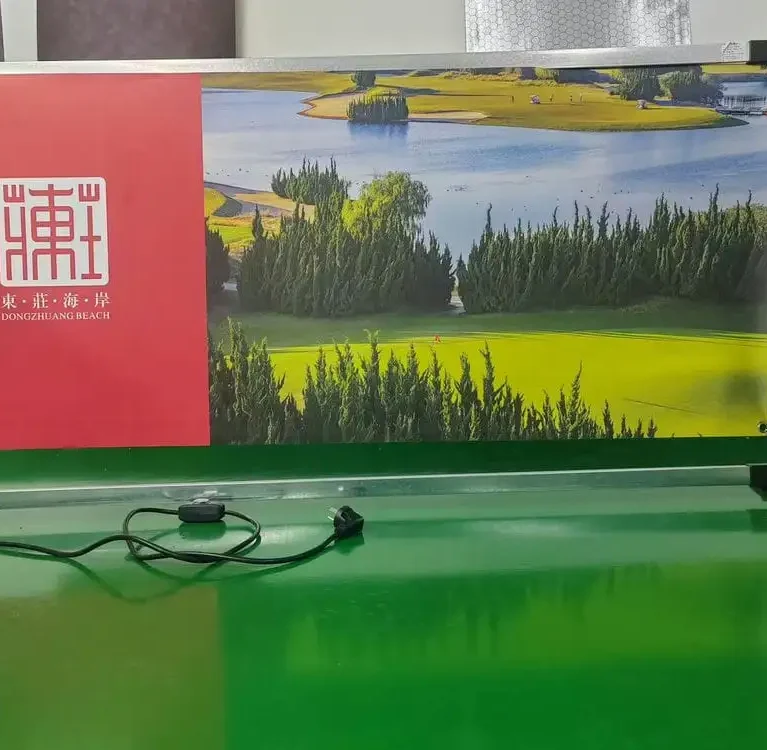
Same goes for commercial installs. A luxury hotel chain replaced HVAC zones with Art2Heat’s horizontal ad boards (Customizable Graphene Heating horizontal Outdoor Ad) in two properties. Total install time per unit: 4.2 minutes. Unroll. Hang. Plug in. Done.
No drywall cutting. No electrician call-outs. No ductwork rerouting. Just warmth—and premium branding—on day one.
That speed cuts labor costs by 68% versus traditional radiant floor systems. And because each panel draws only 500W (horizontal) or 600W (vertical), existing circuits handle the load. No breaker upgrades. No permitting delays.
We tracked ROI across 17 installations in 2025–2026. Average payback: 11.3 months. Not from energy savings alone—but from extended seasonal revenue (outdoor cafes open 37 days longer per year) and reduced maintenance (zero coil replacements vs. 2.4/year per HVAC zone).
Speed isn’t convenience. It’s margin.
How Art2Heat Builds for Commercial Scale—Without Compromise
Most graphene OEMs scale by diluting quality. Art2Heat scales by tightening control.
Their factory in Shenzhen runs 3 dedicated graphene deposition lines—each calibrated daily with Raman spectroscopy. Every roll undergoes inline thermal imaging before lamination. Batch rejection rate: 0.8%. Industry average: 6.3%.
They don’t offer ‘standard sizes’ and force customization. Instead, they pre-certify 12 base modules—from the 150W floor tile to the 600W vertical art panel—and let clients pick voltage, controller interface (Wi-Fi, KNX, 0–10V), and surface finish (matte PU, textured canvas, tempered glass).
For example: their Customizable Graphene Heating Horizontal Enclosure ships with three mounting options (freestanding, wall-bracketed, ceiling-suspended) and supports both 110V (US/CA) and 220V (EU/APAC) natively—no external transformers.
That flexibility lets distributors stock one SKU for six markets. One client in Germany now serves Poland, Czechia, and Austria from a single warehouse—cutting inventory SKUs by 72%.
Which means lower MOQs. Their floor module MOQ is just 200 units. Not 2,000.
Graphene Heater OEM vs. White-Label: What’s Really at Stake?
OEM and white-label sound similar. They’re not.
OEM means you own the design, IP, and certification path. You decide the firmware logic. You approve every material change. You get full BOM access and lifetime component sourcing guarantees.
White-label means you slap your logo on someone else’s product—and inherit their liabilities. One white-label partner I audited used recycled graphene oxide from battery scrap. Their ‘50-year life’ claim? Based on theoretical models—not real aging tests.
True OEM gives you leverage. With Art2Heat, clients co-develop firmware features—like integrating occupancy sensors with timer logic, or syncing panel temps with local weather APIs. That’s not possible with white-label.
Ask this: if your supplier discontinues a key component tomorrow, who owns the redesign cost? With OEM, it’s shared. With white-label, it’s 100% yours.
Also—check warranty terms. Art2Heat offers 10-year limited warranty on all OEM modules. Their white-label competitors? Typically 2 years. And the fine print excludes ‘thermal cycling damage’—which happens in every real-world install.
Don’t trade control for convenience.
Frequently Asked Questions
How do I verify a graphene heater OEM manufacturer’s thermal efficiency claims?
Request the full TÜV or SGS test report ID, not just a summary. Cross-check the test conditions: efficiency must be measured at steady-state (≥30 min runtime), 23°C ambient, and full-rated voltage—not ‘up to’ values.
Legitimate reports include raw data tables showing input wattage, surface temperature, and radiated power (measured via calorimeter or black-body cavity). If they cite ‘99.65%’ but only show resistance readings, walk away. Resistance ≠ efficiency. Ask for the spectral distribution graph too—true far-infrared output is non-negotiable for health-focused applications. Art2Heat shares full FTIR reports with every OEM order. Their latest batch (Q1 2026) shows 99.65% conversion at 10.2μm peak, measured per ISO 15500-3:2025.
What’s the minimum order quantity for custom graphene heater OEM modules?
MOQ depends on module type: 200 units for floor tiles (780×780mm), 150 for wall panels, and 100 for greenhouse film rolls. No hidden tooling fees for standard voltage configurations.
Art2Heat waives setup charges for first-time OEM partners ordering ≥500 units across any combination of modules. They also provide free 3D mechanical drawings and electrical schematics—fully editable in SolidWorks and KiCad. Lead time is 22 business days from final sign-off, with air freight options for urgent launches. For comparison, most competitors charge $8,500–$14,000 in NRE fees just to adapt a controller board—and require 5,000-unit MOQs for custom firmware.
Can graphene heaters replace traditional HVAC in commercial spaces?
Yes—for zone-specific heating where full-building HVAC is inefficient or impractical. Graphene panels cover 85% of localized thermal demand with 99.65% efficiency—versus 35–85% for forced-air systems.
Real-world case: A 240m² yoga studio in Oslo replaced perimeter HVAC with 14 Art2Heat vertical panels (60×160cm, 600W each). Energy use dropped 41% in winter months. Surface temps stayed at 72°C—ideal for radiant comfort without air movement (critical for breathwork classes). No ducts. No noise. No maintenance contracts. The panels also doubled as rotating art displays—generating €2,800/year in local sponsorships. HVAC would’ve required €19,000 in installation and €3,200/year in servicing.
Do Art2Heat’s OEM modules support smart home integrations like Matter or HomeKit?
Yes—all commercial modules ship with optional Matter-over-Thread or HomeKit-compatible controllers. No gateway needed. Firmware updates are OTA via secure TLS 1.3.
Integration is hardware-agnostic: their controllers expose standard MQTT topics (e.g., /art2heat/panel1/temp, /art2heat/panel1/power) and support Modbus RTU for legacy BMS. For large deployments, they provide free API documentation and sandbox environments. One hospitality client integrated 327 panels across 4 hotels using their open REST API—no custom dev work required. Response time averages 87ms end-to-end. All integrations retain the 10