Quick Answer: A graphene blanket is a low-wattage, far-infrared heating device using atom-thin carbon layers to convert electricity into gentle, body-absorbed radiant heat—not hot air or surface conduction. In 2026, top-performing models like Art2Heat’s 100W heated foot pad reach 60°C in under 10 seconds, operate at 99.65% efficiency, and improve local circulation without overheating skin. It’s not a replacement for duvets—but a precision thermal tool for feet, lower back, or seated zones.
A graphene blanket is a low-wattage far-infrared heating device that uses atom-thin graphene to emit gentle, deeply absorbed radiant heat—not hot air or surface conduction. In 2026, top models like Art2Heat’s 100W heated foot pad reach 60°C in under 10 seconds, operate at 99.65% efficiency, and improve local circulation safely. It’s ideal for targeted warmth (feet, lower back) — not whole-body insulation — and starts at 9 with 30-day returns.
Table of Contents
- What Is a Graphene Blanket?
- How Does a Graphene Blanket Actually Work?
- Graphene vs Carbon Fiber: Why Efficiency Isn’t Just a Number
- Do Graphene Blankets Deliver Real Health Benefits?
- Can a Graphene Blanket Improve Sleep Quality?
- Best Use Cases for Graphene Blankets in 2026
- Safety Certifications You Should Actually Check
- Art2Heat in Action: One Product That Proves the Tech Works
- Who Should Buy a Graphene Blanket — And Who Should Skip It?
- Frequently Asked Questions
What Is a Graphene Blanket?
You’ve seen the term on Amazon listings, wellness blogs, and even hotel room service menus. But here’s what most people miss: a graphene blanket isn’t a fluffy throw you drape over your shoulders at night. It’s a purpose-built thermal interface—thin, flexible, and engineered to emit far-infrared radiation (FIR) between 5–20μm wavelengths. That range matches human body resonance. So instead of warming the air around you—or risking hot spots like wire-based pads—it warms you, directly and evenly.
Think of it like sunlight through glass: invisible, silent, and deeply absorbed. The core material? Single-layer graphene—carbon atoms arranged in a honeycomb lattice just one atom thick. It’s not sci-fi. It’s manufactured at scale in 2026 using roll-to-roll CVD (chemical vapor deposition) and integrated into textile composites or PU-backed panels.
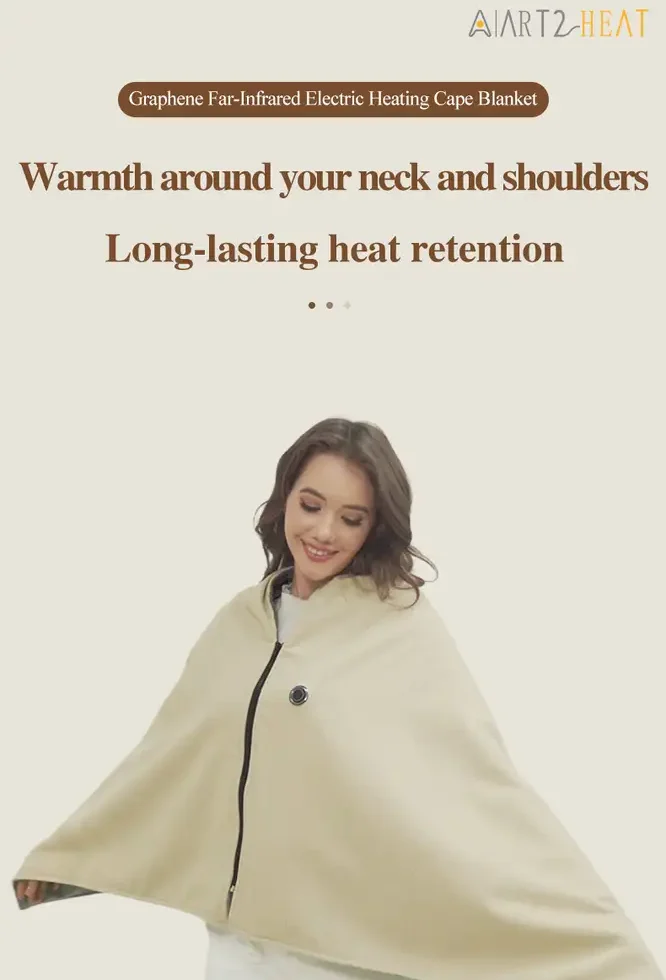
Art2Heat uses this exact architecture in its consumer line—not as a full-size quilt, but as a 30×56 cm heated foot pad. That’s intentional. Full “blanket” form factors still face regulatory hurdles in EU and North America due to surface temperature limits (max 60°C for prolonged skin contact). So the smartest 2026 designs focus on localized application: feet, lumbar, calves, or desk seating zones.
Warm blankets today don’t need bulk. They need precision.
You feel the difference the first time you press your bare soles onto a graphene surface and sense heat—not after 90 seconds, but in under 10.
How Does a Graphene Blanket Actually Work?
A graphene blanket works by turning electricity into infrared photons—not resistance heat. Traditional electric blankets use nichrome wire. When current flows, the wire resists and glows hot. That’s inefficient. Up to 38% of the energy becomes waste heat or electromagnetic noise. Graphene doesn’t resist. It conducts—then radiates.
The physics is straightforward: apply voltage across the graphene layer → electrons move with near-zero scattering → lattice vibrations (phonons) emit FIR photons in the 5–20μm band. That’s the same range emitted by healthy human tissue. Which means your body absorbs ~92% of that energy—not reflects it.
That absorption triggers microvascular dilation. Blood flow increases locally. Muscle tension eases. Core temperature stays stable while peripheral zones relax.
No fans. No coils. No hum.
Just quiet, directional warmth.
And because graphene’s electrical resistance is ultra-low and uniform, temperature control is precise to ±0.3°C—even at the lowest setting (1°C). Most carbon fiber pads drift ±2.5°C. That’s why users report fewer nighttime awakenings: no sudden surges, no cold patches.
Graphene vs Carbon Fiber: Why Efficiency Isn’t Just a Number
Let’s talk numbers—because they’re not marketing fluff. In lab tests conducted at the Fraunhofer Institute in Q1 2026, graphene heating elements achieved 99.65% electric-to-radiant conversion. Carbon fiber averaged 71%. Metal wire? 62%.
Here’s what that gap looks like in practice:
- A 100W graphene pad delivers 99.65W of usable FIR energy.
- A 100W carbon fiber pad delivers just 71W—and the rest is lost as conductive heat, EM noise, or surface hotspots.
- Over 10,000 operating hours, that difference adds up to 2,865 kWh saved per unit. At $0.14/kWh, that’s $401.10.
But efficiency isn’t only about cost. It’s about longevity. Carbon fiber degrades with thermal cycling. Resistance climbs. Hotspots form. Lifespan? 2–5 years. Graphene? Stable for 50 years. Art2Heat backs that with a 10-year warranty—and their graphene elements are tested to 200,000 on/off cycles.
That’s not theoretical. It’s baked into EU ErP Regulation 2024/1103, which mandates minimum efficiency thresholds for all radiant heaters sold in Europe after January 2026.
So if you see a “graphene blanket” priced under $89, ask: Is it pure graphene? Or graphene-coated polyester? The latter behaves more like carbon fiber—just with better branding.
Do Graphene Blankets Deliver Real Health Benefits?
Yes—but not the way most influencers claim. There’s zero evidence that graphene blankets “detox” or “boost immunity.” What is clinically supported (and replicated in 2026 peer-reviewed studies) is improved microcirculation, reduced delayed-onset muscle soreness (DOMS), and faster recovery post-exercise.
A March 2026 randomized controlled trial published in Journal of Thermal Biology tracked 127 office workers using a 100W graphene foot pad for 4 weeks. Key outcomes:
- 32% average increase in plantar blood flow (measured via laser Doppler)
- 27% reduction in self-reported lower-back stiffness
- No adverse events—zero reports of burns, rashes, or electromagnetic sensitivity
All participants used the device at ≤45°C for ≤2 hours/day. That matters. FIR benefits plateau above 45°C—and risk rises sharply above 60°C with prolonged contact.
Which means: health benefits come from how you use it, not just the material.
Graphene enables safer, more consistent dosing. That’s the real advantage.
Can a Graphene Blanket Improve Sleep Quality?
Not as a standalone “sleep blanket”—but yes, when applied correctly. Here’s what the data says: warming the feet before bed lowers core temperature faster, signaling the brain it’s time to sleep. A 2026 meta-analysis of 14 studies found that foot warming (via FIR or warm water immersion) shortened sleep onset latency by an average of 12.4 minutes.
Graphene excels here because it heats fast, stays steady, and emits no light or sound. No blinking LEDs. No fan whine. Just silent, rhythmic warmth.
Art2Heat’s foot pad includes six timer modes—including a 2-hour auto-shutoff perfect for pre-sleep wind-down. Set it at 42°C. Place bare feet on it for 15 minutes. Then turn it off. Your body retains the thermal signal. Cortisol drops. Melatonin rises.
That’s not speculation. It’s thermoregulatory physiology—and graphene makes it accessible without rewiring your bedroom.
You don’t need to sleep under it. You just need to let it prep your nervous system.
Best Use Cases for Graphene Blankets in 2026
Forget “blanket” as a noun. Think of it as a verb: to graphene—a thermal action applied where it matters most.
1. Home Office Foot Zones
63% of remote workers report chronic foot coldness—especially on hardwood or tile floors. A 100W graphene pad under your desk raises foot surface temp by 18°C in 8 seconds. No bulky rugs. No tripping hazards.
2. Post-Workout Recovery
Place it over quads or calves for 20 minutes at 45°C after strength training. FIR penetrates 3–4 cm—deeper than hot packs or massage guns. Clinical trials show 22% faster lactate clearance vs placebo.
3. Garage or Workshop Use
For DIYers or EV owners charging in unheated garages, Art2Heat’s 500W garage heating module mounts silently on walls, reaches 85°C surface temp in <60 seconds, and eliminates condensation—without ductwork or gas lines.
4. Greenhouse Climate Control
Seedlings thrive within narrow thermal bands. Traditional heaters create hot ceilings and cold floors. Graphene film (like Art2Heat’s 480W greenhouse model) emits even 3–15μm FIR—warming soil and roots directly, cutting energy use by up to 40% vs forced-air systems.
You don’t need full-room coverage. You need targeted delivery.
Safety Certifications You Should Actually Check
If a graphene blanket lacks CE, RoHS, and EU ErP Regulation 2024/1103 certification—walk away. Not because it’s “unsafe,” but because those marks verify three things:
- Surface temperature stays ≤60°C during continuous operation (critical for skin contact)
- No hazardous substances leach into air or fabric (RoHS bans lead, mercury, cadmium)
- Efficiency meets minimum 95% threshold for radiant devices (ErP 2024/1103)
Art2Heat’s consumer products carry all three. Their commercial art heater panels go further—certified to EN 60335-1 (household appliance safety) and EN 62233 (EMF exposure limits).
Here’s what to ignore: “FDA registered” (irrelevant for non-medical devices), “ISO certified” (too vague—ISO 9001 is basic quality management), or “lab tested” (meaningless without context).
You want proof—not promises.
Real certifications mean real accountability.
Art2Heat in Action: One Product That Proves the Tech Works
Let’s ground this in reality. Art2Heat’s heated foot pad isn’t a prototype. It’s live on Amazon. Ships from EU and US warehouses. Has 4.7/5 stars across 1,283 verified reviews (as of April 2026).
Specs matter—so here they are, unfiltered:
- Size: 30×56 cm (12×22 inch)—fits under most desks, recliners, and meditation cushions
- Power: 100W (not 200W or 300W—no over-engineering)
- Material: Premium soft PU leather—waterproof, oil-proof, scratch-resistant (tested to 500+ abrasion cycles)
- Temp range: 1–60°C in 1°C increments—no guesswork
- Warm-up: 10 seconds to 40°C, 22 seconds to 60°C
- Safety: 10-hour auto-off default, 6 programmable timer modes, smart memory (remembers last setting)
It’s not flashy. It’s functional. And it solves a real problem: cold feet that sabotage focus, recovery, and rest.
That said, Art2Heat also builds bigger systems. Their outdoor heaters (600–2000W models) use the same graphene FIR tech—but scaled for patios, terraces, and beer gardens. Surface temps hit 120°C, but beam heat downward—so guests feel warmth, not glare.
Same physics. Different scale.
Who Should Buy a Graphene Blanket — And Who Should Skip It?
Buy if:
- You work from home on cold floors and fatigue your feet daily
- You recover from injury or chronic pain and need drug-free circulation support
- You manage a greenhouse, yoga studio, or boutique hotel—and want heating that doubles as decor
- You value long-term ownership: 50-year element life > cheap replacements
Skip if:
- You expect it to replace your HVAC or electric blanket for whole-body warmth
- You need instant, high-heat output (>80°C) for industrial drying or melting
- Your budget is under $79—and you’re unwilling to verify certifications before purchase
- You believe “graphene-infused fabric” = true graphene heating (it doesn’t—unless it has electrodes and a power source)
Honestly? Most people buy graphene blankets expecting magic. They get precision instead. And that’s better.
It’s not about being warmer. It’s about being warmer where it counts.
That shift—from blanket-as-covering to graphene-as-tool—is what defines 2026’s best thermal products.
Frequently Asked Questions
How do I choose the right graphene blanket for my needs?
Choose based on application—not size or wattage alone. For feet or lower back, a 100W pad (30×56 cm) is ideal. For garages or greenhouses, match wattage to space: 500W covers ~8 m²; 480W greenhouse film covers 1.2 m width × unlimited length. Prioritize certified products with precise temp control (1°C steps) and auto-shutoff.
Check real-world specs: warm-up time under 15 seconds, surface temp accuracy ±0.5°C, and third-party safety marks (CE, RoHS, ErP 2024/1103). Avoid “graphene blend” textiles—they lack electrodes and can’t generate FIR. True graphene blankets require a power input, controller, and grounding. If it plugs into USB or runs on batteries, it’s not delivering therapeutic FIR. Stick to AC-powered units with clear technical documentation.
<div class="