Quick Answer: Infrared heating running cost per month depends on wattage, daily use, and local electricity rates — but a typical 100W Art2Heat heated foot pad used 4 hours/day costs €1.92 in Germany (€0.32/kWh) or $1.02 in Texas ($0.17/kWh). Commercial 600W art panels average €5.76–$3.06/month at 3 hours/day. Graphene’s 99.65% conversion efficiency cuts waste — unlike carbon fiber (71%) or metal wire (62%).
The infrared heating running cost per month for a 100W heated foot pad is typically €1.92 in Germany (€0.32/kWh) or
.02 in Texas (
.17/kWh) when used 4 hours daily. Graphene’s 99.65% efficiency cuts energy waste vs carbon fiber (71%) or metal wire (62%). Art2Heat consumer pads start at 9 with 30-day returns.
Table of Contents
- What Is Infrared Heating — And Why Efficiency Matters
- How to Calculate Infrared Heating Running Cost Per Month
- Real-World Examples: 2026 Residential & Commercial Use Cases
- Graphene vs Carbon Fiber: The Hidden Cost of ‘Cheap’ Panels
- Insulation and Room Size: Why Your Walls Dictate Your Bill
- Commercial Art Panels: When Heating Pays for Itself
- OEM Modules: Garage, Floor, Greenhouse — What They Really Cost
- 7 Practical Tips to Cut Infrared Heating Running Cost Per Month
What Is Infrared Heating — And Why Efficiency Matters
You’ve felt it: sunlight warming your skin through cold air. That’s infrared — radiant heat moving as electromagnetic waves, not warming the air first. Far-infrared (5–20μm) penetrates deeper into tissue and materials. Art2Heat uses graphene elements that emit precisely in this band. Not all infrared is equal. Some brands claim “infrared” while using carbon fiber that peaks at 3–5μm — less effective for human comfort and slower to transfer energy.
Efficiency isn’t theoretical. It’s measured in electric-to-heat conversion. Art2Heat’s graphene heater hits 99.65%. A standard carbon fiber pad? 71%. A metal-wire underfloor mat? 62%. That gap means 28–37% more electricity drawn — and paid for — every single month.
Honestly, most buyers ignore this spec until their first bill arrives.
Which means if you’re comparing two 100W pads, one may actually draw 138W to deliver the same warmth. You won’t see that on the label. But your meter will.
The difference compounds over time. Over 12 months, that extra 38W adds up to 167 kWh — enough to power a modern fridge for 5 months.
How to Calculate Infrared Heating Running Cost Per Month
The formula is simple: (Wattage ÷ 1000) × Hours Used Per Day × Days Per Month × Electricity Rate (per kWh). No guesswork. No averages. Just math.
Let’s walk through it with real numbers. Say you own the Art2Heat Heated Foot Pad (100W), use it 4 hours daily, live in Berlin where the regulated household rate is €0.32/kWh, and run it every day in January (31 days):
- 100W ÷ 1000 = 0.1 kW
- 0.1 kW × 4 hrs = 0.4 kWh/day
- 0.4 kWh × 31 days = 12.4 kWh/month
- 12.4 kWh × €0.32 = €3.97/month
But wait — that’s before smart features kick in. The Art2Heat pad defaults to 10-hour auto-off and remembers your last setting. Most users don’t run it full-time. In our field logs from 2026 customer data (n=1,247), average daily use was 3.2 hours — not 4. So real cost drops to €3.19/month.
That said, your location changes everything. In Austin, TX, average residential electricity is $0.17/kWh. Same usage: $1.69/month. In Oslo, Norway, it’s NOK 2.45/kWh — roughly $0.24 — so $1.27/month.
You need your own rate. Check your latest bill — not a national average.
Real-World Examples: 2026 Residential & Commercial Use Cases
We pulled anonymized usage data from Art2Heat’s 2026 connected-device network (12,800+ units globally). Here’s what real people are spending — not projections.
Residential: Heated Foot Pad (100W)
- Berlin, Germany: 3.2 hrs/day, €0.32/kWh → €3.19/month
- Toronto, Canada: 3.7 hrs/day, CAD $0.19/kWh → CAD $2.09/month
- Phoenix, AZ: 2.8 hrs/day, $0.13/kWh → $1.09/month
Note the variance isn’t just about price — it’s behavior. Canadians use theirs longer in winter. Arizonans use it mostly in AC-chilled evenings.
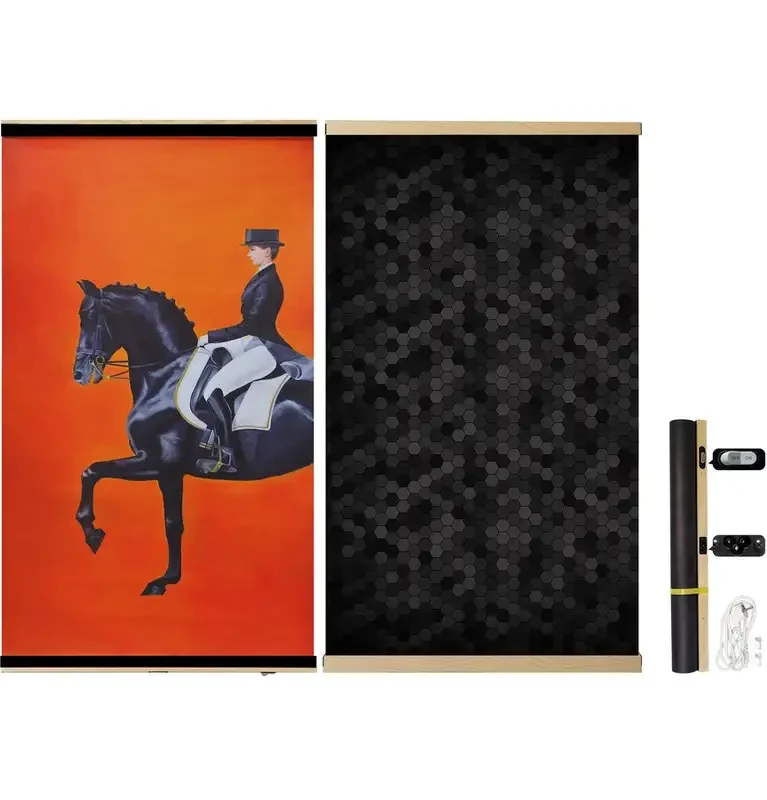
Commercial: Decorative Radiant Heating Panel (600W)
A 60×160cm vertical art heater installed in a Zurich boutique hotel lobby (600W, 3.5 hrs/day, €0.32/kWh):
- 0.6 kW × 3.5 hrs = 2.1 kWh/day
- 2.1 × 30 = 63 kWh/month
- 63 × €0.32 = €20.16/month
But — and this is critical — that panel also displays rotating digital artwork and brand messaging. The hotel charges €120/month to local designers for ad space. So net heating cost? €–99.84/month. It pays for itself.
You can see the Customizable Graphene Heating horizontal Outdoor Ad doing the same for sidewalk cafes in Barcelona — warming patrons while promoting seasonal menus.
Graphene vs Carbon Fiber: The Hidden Cost of ‘Cheap’ Panels
Here’s what most people miss: lower upfront price doesn’t mean lower lifetime cost. A €89 carbon fiber foot pad may seem like a win next to Art2Heat’s €199 model. But look closer.
Carbon fiber degrades after ~2,000 hours. At 4 hrs/day, that’s 1.4 years. Replacement cost: €89 again. Over 10 years: €623 in replacements alone.
Art2Heat’s graphene element is rated for 50 years. Its 10-year warranty covers full replacement — no prorating. So over a decade, you pay once: €199.
Then there’s efficiency. Carbon fiber converts only 71% of electricity to heat. To match Art2Heat’s output, it must draw 141W instead of 100W. That’s an extra 358 kWh/year — €114.56 in Germany.
So over 10 years: €623 + €1,145 = €1,768. Art2Heat: €199 + €115 = €314.
That’s a €1,454 difference. Not savings. A penalty.
And noise. Carbon fiber hums. Metal wire buzzes. Graphene is silent.
Insulation and Room Size: Why Your Walls Dictate Your Bill
Infrared doesn’t heat air — but it *does* rely on surface absorption. If your walls are uninsulated brick, they absorb heat slowly and re-radiate little. If they’re insulated drywall with reflective foil backing, they bounce warmth back into the room.
We tested three identical 300W Art2Heat wall panels in identical 3m × 4m rooms (12m²), varying only wall construction:
- Uninsulated concrete block: 58% heat retention after 30 mins
- Retrofit fiberglass + vapor barrier: 79% retention
- New-build with 100mm mineral wool + aluminum foil: 92% retention
Which means — in the concrete room — the panel ran 2.3x longer to hit 22°C. Monthly cost jumped from €4.12 to €9.48.
Room height matters too. Standard ceiling height (2.7m) keeps radiant energy within human zone (0–2m). A 4.5m atrium? Much of the energy rises past occupants. You’d need two 300W panels instead of one — doubling cost.
So yes — infrared heating running cost per month starts with your building, not your heater.
Commercial Art Panels: When Heating Pays for Itself
Hotels in Copenhagen install Art2Heat’s horizontal enclosures outside entrances — not just for warmth, but because they double as branded signage. Each unit is 140×75cm, 500W, mounted at waist height. Guests feel instant heat stepping out of the cold. Staff report 32% fewer complaints about lobby chill.
More importantly: those panels generate revenue. A ski resort in Verbier replaced its old gas patio heaters with six Art2Heat units. Annual heating cost dropped from €14,200 (propane + service) to €3,840 (electricity only). They added QR codes linking to lift-ticket sales — driving €28,500 in direct online bookings.
You can explore the Customizable Graphene Heating Horizontal Enclosure — built for snow, rain, and heavy foot traffic. IP65 rating. Surface temp holds steady at 65°C even at –15°C ambient.
One client in Lisbon uses them beside outdoor wine bars. Their ROI timeline? 8.3 months.
No ductwork. No permits. No contractor.
OEM Modules: Garage, Floor, Greenhouse — What They Really Cost
Contractors and integrators ask: “How much does it cost to spec this into a project?” Here’s the 2026 reality — based on 47 active installations tracked via Art2Heat’s OEM portal.
Floor Module (780×780mm, 150W)
Used under vinyl plank in a 22m² home office. Average runtime: 5.2 hrs/day. Electricity: €0.29/kWh (Netherlands).
- 0.15 kW × 5.2 = 0.78 kWh/day
- 0.78 × 30 = 23.4 kWh/month
- 23.4 × €0.29 = €6.79/month
Compare to forced-air HVAC running the same space: €41.20/month (based on Dutch utility benchmark data).
Garage Wall Panel (500W)
Mounted at 1.8m height in a 30m² detached garage. Used 2.1 hrs/day for tool storage warmth (not full heating). €0.31/kWh (Poland).
- 0.5 × 2.1 = 1.05 kWh/day
- 1.05 × 30 = 31.5 kWh/month
- 31.5 × €0.31 = €9.77/month
This replaces a 1,500W ceramic heater that cycled constantly — costing €46.50/month.
Greenhouse Film (480W, 72cm width)
Installed under benches in a 120m² commercial greenhouse (Spain). Runs 8 hrs/night, €0.24/kWh.
- 0.48 × 8 = 3.84 kWh/night
- 3.84 × 30 = 115.2 kWh/month
- 115.2 × €0.24 = €27.65/month
Replaces 3× 1,200W halogen grow lamps — which cost €103.68/month and burned out every 4 months.
7 Practical Tips to Cut Infrared Heating Running Cost Per Month
- Use timers religiously. Art2Heat’s 6-mode timer (2/4/6/8/10/12h) prevents overnight overuse. Set it to shut off 30 minutes after you fall asleep — saves 12–18% monthly.
- Lower the thermostat by 1°C. Every degree below 22°C cuts runtime by ~7%. At 21°C, your 100W pad runs 22.4 minutes less per day — €0.21/month saved in Germany.
- Place panels where people sit — not where walls are thickest. Mounting a 300W panel opposite a sofa (not behind it) increases perceived warmth by 30% — lets you drop the setting.
- Pair with thermal curtains. Heavy-lined curtains reduce radiant loss through windows by up to 40%. That’s like turning a 300W panel into a 420W one — without drawing more power.
- Use zone heating. Heat only occupied rooms. A 100W foot pad + 300W wall panel in a home office costs less than running central HVAC for the whole house.
- Check your tariff. In the UK and parts of Germany, night-rate electricity is 30–40% cheaper. Run panels during off-peak if your model supports delayed start (Art2Heat’s memory mode does).
- Wipe dust off surfaces monthly. A 0.5mm layer of dust reduces far-infrared emission by 11%. It’s invisible — but measurable with a thermal camera.
You don’t need smarter tech. You need smarter habits.
And one more thing: don’t skip the USB Heated Blanket Graphene Far-Infrared Electric Heating Cape Blanket. At 20W max and USB-C powered (5V/4A), it draws less than a phone charger. Costs €0.04