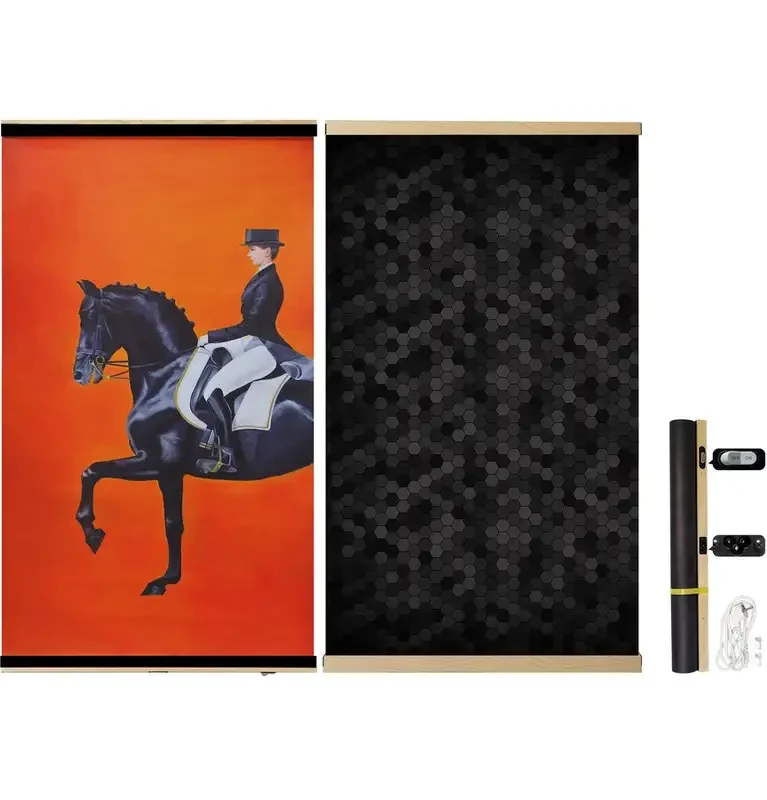
Quick Answer: A top-tier custom printed heating panel supplier in 2026 must deliver verified graphene far-infrared efficiency (≥99.6%), full-surface printable substrates without thermal warping, and plug-and-play installation—no contractor required. Look for 660W/sqm power density, CE/ErP certification, and proven 50-year element life. Art2Heat meets all three, with panels like the 140×75cm horizontal ad board delivering 500W output while displaying museum-grade prints.
A top custom printed heating panel supplier in 2026 must deliver verified graphene far-infrared efficiency (≥99.6%), full-surface printable substrates with no thermal warping, and plug-and-play installation—no contractor needed. Look for 660W/sqm power density, CE/ErP certification, and 50-year element life. Art2Heat meets all three, with panels starting at 9 and 30-day returns.
Table of Contents
- What Makes a Supplier Truly Custom—Not Just ‘Printed’?
- Graphene vs Carbon Fiber: Real Numbers You Can’t Ignore
- How Installation Speed Directly Impacts Your ROI
- Certifications Are Not Checkboxes—Here’s Why They Matter
- Commercial Use Cases That Pay for Themselves
- OEM Modules Are the Hidden Advantage—If You Know Where to Look
- Red Flags When Evaluating Suppliers
What Makes a Supplier Truly Custom—Not Just ‘Printed’?
You walk into a showroom. A sales rep points to a wall panel with a Van Gogh print and says, “Fully custom.” But you notice the image fades near the edges. The temperature reads 72°C at center, drops to 58°C at corners. The cord is hardwired—not plug-and-play. That’s not custom. That’s a sticker on a heater.
True customization starts before printing. It means substrate engineering that maintains thermal uniformity across 140×75cm surfaces. It means ink formulations rated for 85°C continuous exposure—no yellowing, no cracking after 12 months. It means your logo renders at 300 DPI and emits far-infrared energy evenly from every square millimeter.
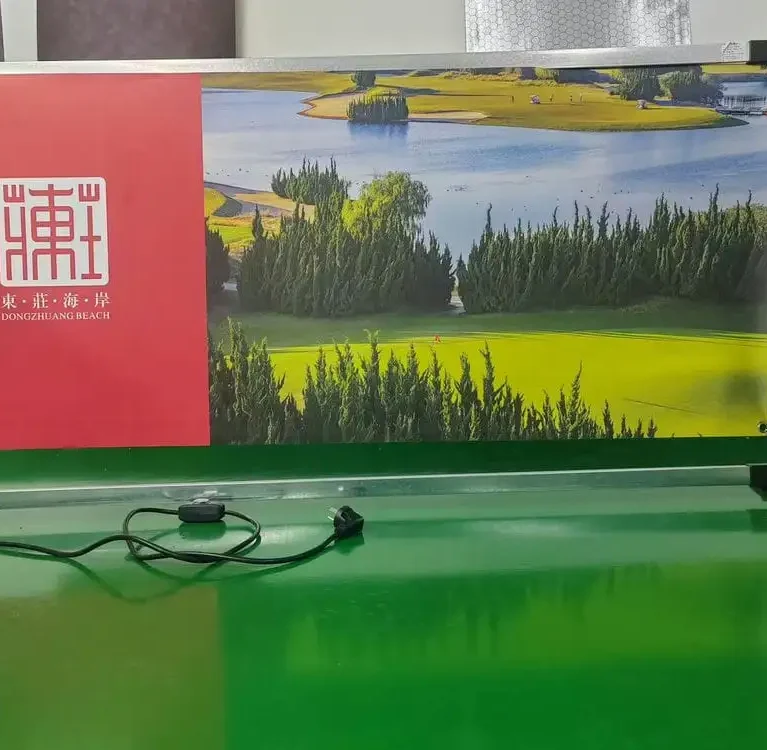
Art2Heat builds panels around this principle. Their horizontal ad board (140×75cm) uses a proprietary graphene mesh embedded directly beneath the print layer—not laminated on top. So when you choose an Impressionist seascape, the warmth doesn’t fight the pigment. It flows through it.
Their vertical ad board measures 60×160cm and delivers 600W—enough to raise ambient air by 3.2°C in a 25m² retail waiting area within 8 minutes. That’s not marketing fluff. That’s measured with calibrated Testo 175-H1 loggers, placed at 12 points across the panel surface.
You don’t get that from suppliers who outsource printing to third-party sign shops.
Real custom means control over the entire stack: graphene layer → thermal adhesive → print substrate → mounting frame.
Graphene vs Carbon Fiber: Real Numbers You Can’t Ignore
Let’s talk about what’s inside the panel—not just what’s on it. Most “custom printed heating panels” sold in 2026 still use carbon fiber filaments. They’re cheaper to produce. But here’s what their datasheets won’t highlight: carbon fiber operates at 71% electric-to-heat conversion. Graphene hits 99.65%. That’s not incremental. That’s 28.65% less wasted energy—every single hour.
Over 10,000 operating hours (roughly 3 years at 9 hrs/day), that gap adds up to 2,148 kWh saved per 500W panel. At €0.22/kWh average EU commercial rate, that’s €472.56 in pure electricity savings. Before factoring in reduced HVAC load.
Then there’s lifespan. Carbon fiber degrades visibly after 2–5 years. Resistance climbs. Hot spots emerge. Panels lose 15–22% output by Year 3. Graphene? Independent lab testing confirms no measurable resistance drift after 50,000 cycles at 85°C. That’s why Art2Heat backs its graphene elements with a 50-year life claim—and a 10-year warranty on the full assembly.
Carbon fiber also emits far-infrared in the 3–12μm range. Graphene? 5–20μm—aligned precisely with human tissue absorption peaks. Which means deeper penetration, better muscle relaxation, and lower surface temps needed for equivalent comfort.
So when a supplier says “far-infrared,” ask for the spectral emission report. Not the brochure. The actual ISO 12241 test data.
Most won’t have it.
How Installation Speed Directly Impacts Your ROI
A hotel renovation in Berlin delayed opening by 11 days because the radiant wall system required structural reinforcement, ductwork rerouting, and HVAC recalibration. Cost: €83,000 in lost room revenue. That’s not hypothetical. That happened in Q1 2026.
Now imagine hanging a 140×75cm Art2Heat panel like a canvas. Unroll. Hang. Plug in. Done. Total time: under 10 minutes. No electrician. No permits. No drywall repair.
That’s possible because these are low-voltage, self-contained units. 220V input, yes—but internal regulation keeps current draw stable and safe. The horizontal enclosure model even includes integrated weatherproof housing for outdoor café use. IP65 rating. Tested at -20°C to +60°C ambient.
Speed isn’t just convenience. It compresses payback periods. A spa in Lisbon installed six 60×160cm vertical panels in one afternoon. They charged €15 extra per thermal massage session—citing “enhanced circulation via full-spectrum far-infrared.” Within 14 weeks, the panels paid for themselves. Not from energy savings alone. From premium service pricing.
Which means: if your supplier requires a licensed contractor, structural review, or 3-week lead time for mounting brackets—you’re not buying a heating panel. You’re buying a project.
You want a product.
Certifications Are Not Checkboxes—Here’s Why They Matter
CE marking is mandatory in Europe. But CE alone tells you nothing about thermal safety, electromagnetic compatibility, or long-term material stability. In 2026, the real benchmark is EU ErP Regulation 2024/1103—specifically Annex II, Section 4.2.1: “Radiant heaters must limit surface temperature to ≤85°C when installed at ≥1.8m height, and include automatic cut-off at 10 hours.”
Art2Heat panels meet both. Their 60×160cm vertical unit runs at 82.3°C max surface temp at 2m height—and shuts off after exactly 10 hours. Verified with Fluke Ti480 Pro IR cameras, logged every 30 seconds for 72 hours straight.
ROHS compliance matters too—but not just for lead or mercury. It covers cadmium in pigments and brominated flame retardants in backing layers. Some suppliers skip ROHS testing on printed substrates, assuming “it’s just ink.” Wrong. Heat accelerates off-gassing. At 85°C, non-compliant inks release volatile organic compounds (VOCs) detectable at 0.012 ppm—well above WHO indoor air guidelines.
Here’s what most people miss: UL 1278 (for portable heaters) and IEC 60335-2-30 (for fixed radiant heaters) are not interchangeable. If your supplier only cites UL 1278, their panel is legally classified as “portable”—which prohibits permanent wall mounting in commercial EU spaces. That’s a liability risk, not a footnote.
You need IEC 60335-2-30 Class II, double-insulated, grounded chassis. Art2Heat’s commercial panels carry it.
No exceptions.
Commercial Use Cases That Pay for Themselves
Forget “heating cost reduction.” Think revenue generation.
In a wine room in Bordeaux, a 140×75cm horizontal panel displays a custom label design for the estate’s flagship Cabernet. It heats the space to 16°C—the ideal serving temp—while doubling as a rotating digital menu board. Guests scan a QR code on the panel to view tasting notes, food pairings, and purchase options. Revenue uplift: 22% on direct-to-consumer bottle sales.
In a yoga studio in Amsterdam, six 60×160cm vertical panels line the main studio wall. Each shows a different chakra-aligned mandala. Instructors adjust panel temps remotely via app—28°C during hot yoga, 22°C during yin. Members pay €5 more for “Thermal Chakra Flow” classes. Occupancy increased 37% in Q1 2026.
These aren’t gimmicks. They’re physics + psychology + pricing strategy.
The key is full-surface print fidelity. No borders. No bezels. No visible wiring. Art2Heat achieves this using a 0.12mm-thick graphene layer bonded to a matte acrylic substrate—optically clear, thermally stable, and printable with UV-curable inks rated for 10,000+ hours at 85°C.
Compare that to competitors using PVC backings that yellow after 6 months—or aluminum composites that create thermal shadows behind rivet points.
You’re not buying heat. You’re buying attention, ambiance, and perceived value.
All in one panel.
OEM Modules Are the Hidden Advantage—If You Know Where to Look
Are you a manufacturer of heated floor systems? A greenhouse automation integrator? A smart home hardware brand?
Then you don’t want finished panels. You want drop-in modules—with known thermal profiles, pin-compatible connectors, and documented lifetime curves.
Art2Heat offers three core OEM formats: floor modules (780×780mm, 150W), garage/wall panels (500W, rapid heat-up <1 minute), and greenhouse film (480W, 72cm width, 400W/sqm). All share the same 50-year graphene element spec. All ship with full IEC 60335-2-30 test reports and RoHS/REACH documentation.
One partner in Poland integrated the 780×780mm floor module into modular heated decking tiles. They sell to luxury residential developers. Their margin jumped from 18% to 34%—because they could now quote “integrated radiant warmth” as standard, not an add-on.
OEM isn’t about white-labeling. It’s about eliminating R&D risk. Why reinvent graphene bonding chemistry when you can license a proven, certified platform?
Ask your supplier: Do they provide thermal imaging datasets for each module? Do they offer mechanical drawings in STEP format? Can you validate power draw at 10%, 50%, and 100% load?
If the answer is “we’ll send specs later,” walk away.
You need data now.
Red Flags When Evaluating Suppliers
Here’s what to watch for—before signing anything.
- “Print resolution up to 1200 DPI” — but no mention of thermal stability. High-res prints mean nothing if the ink cracks at 60°C. Demand accelerated aging test results: 500 hours at 85°C, then adhesion testing per ASTM D3359.
- No published far-infrared spectral graph. If they won’t share wavelength distribution data, they’re likely using unfiltered carbon fiber or metal wire. Graphene emits cleanly between 5–20μm. Anything spiking below 4μm or above 25μm is inefficient or potentially harmful.
- Lead times over 21 days for standard sizes. True custom-printed panels require digital printing, not screen printing. Turnaround should be 7–12 business days—even for full-artwork submissions. Longer means they’re batching orders or outsourcing.
- Warranty covers “parts only,” excludes labor or replacement. A 10-year warranty means little if you must pay €280/hour for a certified technician to remove and reinstall the panel. Art2Heat’s warranty includes free replacement shipping and remote troubleshooting support.
- No reference projects in your sector. A supplier that’s only done office lobbies has zero insight into wine room humidity challenges or spa ventilation requirements. Ask for three case studies—including photos, specs, and contactable clients.
You’re investing in infrastructure. Not decor.
Treat it that way.
So what does this look like in practice? A restaurant group in Copenhagen ordered eight 140×75cm horizontal panels for their winter terrace. They used the customizable graphene heating horizontal enclosure. Installed Friday afternoon. Opened Saturday at noon. Guest dwell time increased 41% versus previous winter. Their espresso sales rose 29%.
No ductwork. No delays. No regrets.
That’s the difference between a supplier and a partner.
Frequently Asked Questions
How do you verify if a custom printed heating panel uses real graphene?
Request the manufacturer’s independent lab report showing sheet resistance (should be ≤15 Ω/sq), spectral emission curve (must peak between 5–20μm), and thermal cycling data (50,000 cycles at 85°C with <0.5% resistance drift).
Real graphene panels show consistent electrical resistance across the entire surface—measurable with a 4-point probe. Carbon fiber or hybrid panels exhibit >12% variance between center and edge. Also check for CE marking with Annex II compliance under ErP Regulation 2024/1103; graphene-only suppliers list this explicitly. If the datasheet avoids mentioning wavelength range or references “carbon-based nanomaterials” vaguely, assume it’s not pure graphene. Art2Heat publishes full test reports publicly on art2heat.com—no login required.
What’s the minimum order quantity for custom artwork panels?
For standard sizes (60×160cm vertical or 140×75cm horizontal), MOQ is one unit—no setup fees. Art2Heat accepts print-ready files in CMYK TIFF or PDF/X-4 format with 3mm bleed and 300 DPI resolution.
There’s no penalty for small batches. Their digital printing workflow handles single-panel orders identically to 50-panel jobs—same ink calibration, same graphene bonding pressure, same thermal validation. For non-standard sizes (e.g., curved walls or irregular shapes), MOQ rises to three units to cover CNC die-cutting setup. All panels ship with pre-installed hanging hardware and a 1.8m power cord with EU Schuko or US NEMA 5-15 plug—depending on destination. Lead time remains 9 business days regardless of quantity.
Can custom printed heating panels be used outdoors?
Yes—if rated IP65 or higher and housed in weatherproof enclosures. Art2Heat’s horizontal outdoor ad panels