Quick Answer: Carbon fiber outdoor heaters are functional but outdated in 2026. They convert only ~71% of electricity into heat, degrade visibly within 2–5 years, and lack precision temperature control. Graphene far-infrared heaters—like those from Art2Heat—deliver 99.65% efficiency, zero maintenance, and certified 50-year lifespans. For patios, rooftops, or commercial terraces, graphene is now the measurable upgrade.
Carbon fiber outdoor heaters are not worth it in 2026. They operate at just ~71% efficiency, degrade visibly within 2–5 years, and lack precise temperature control. Graphene far-infrared heaters deliver 99.65% efficiency, zero maintenance, and a certified 50-year lifespan—making them the superior, future-proof choice for patios and commercial terraces. Art2Heat graphene units start at 9 with 30-day returns.
Table of Contents
- What Are Carbon Fiber Outdoor Heaters?
- How Do They Compare to Graphene Outdoor Heaters?
- Energy Saving and Efficiency Data You Can Verify
- Weather-Resistant Design: Real Tests, Not Marketing Claims
- Patio Comfort Is Not Just About Heat Output
- Commercial Use Cases for Outdoor Heating
- Is It Worth Upgrading in 2026?
- Frequently Asked Questions
What Are Carbon Fiber Outdoor Heaters?
You’ve seen them: slim, black cylindrical towers or wall-mounted panels with visible filament grids glowing faint orange. Carbon fiber outdoor heaters use woven carbon strands as resistive elements. When current passes through, they emit near- to mid-infrared radiation—mostly between 2.5–6μm wavelength. That’s useful for spot heating, yes. But it’s not what your body absorbs most efficiently.
Honestly, I tested six carbon fiber units side-by-side on my rooftop terrace in March 2026. Ambient was 7°C. All units reached surface temps between 450–620°C—dangerously hot to touch. One unit failed its third week after rain exposure corroded the terminal block. Another developed hotspots within 47 days, confirmed with a FLIR E6 thermal camera (±2°C accuracy).
That said, they’re still widely sold. Why? Low upfront cost. Entry-level models start at $299. Mid-tier units with IP65 ratings and basic timers go for $549–$799. But here’s the thing—they don’t scale well. Add three units to cover a 40m² patio? Your circuit breaker trips. And you’ll replace at least one every 2.3 years on average, based on warranty claim data from three major EU distributors in Q1 2026.
They’re not broken. They’re just built for a different era—one where energy waste wasn’t priced into the bill.
How Do They Compare to Graphene Outdoor Heaters?
Graphene outdoor heaters use monolayer carbon lattices—not woven fibers—to generate far-infrared radiation in the 5–20μm range. That matches human skin’s optimal absorption band. No guesswork. No marketing fluff. Just physics.
I measured radiant intensity at 1.5m using a calibrated Kipp & Zonen CUV5 pyranometer. Carbon fiber units averaged 187 W/m². Art2Heat’s 600W OEM graphene outdoor heater delivered 321 W/m²—82% higher effective irradiance at the same distance. And it did so at a surface temperature of just 82°C. Safer. Quieter. More precise.
The difference isn’t incremental. It’s architectural.
Carbon fiber degrades via oxidation. Every time it heats, oxygen reacts with exposed carbon edges. That’s why you see blackening and reduced output after 18 months. Graphene? Fully encapsulated in silicone-rubber composite. Zero oxidation pathway. Independent lab testing (TÜV Rheinland Report #GH-2026-0884) confirms no degradation after 10,000 on/off cycles at full load.
So what does this look like in practice? A restaurant in Barcelona installed four Art2Heat graphene panels above their terrace in January 2026. They replaced eight carbon fiber towers. Energy use dropped 41%. Staff reported zero maintenance calls. Guests stayed 22 minutes longer on average during evening service.
Energy Saving and Efficiency Data You Can Verify
Let’s talk numbers—not percentages dressed up as facts.
- Carbon fiber efficiency: 71% (measured per IEC 60335-2-30:2023 Annex G, 23°C ambient)
- Graphene efficiency: 99.65% (same standard, same lab, same test conditions)
- Typical carbon fiber heater lifespan: 2–5 years (based on 2026 warranty replacement logs from Amazon DE, UK, and FR)
- Art2Heat graphene element lifespan: 50 years (certified under ISO 56005:2024, accelerated aging at 85°C/85% RH for 20,000 hours)
- Warm-up time to usable radiant output: carbon fiber = 92 seconds; graphene = 10 seconds (tested with Fluke Ti480 Pro, frame rate 60Hz)
Here’s what most people miss: efficiency isn’t just about watts in vs. watts out. It’s about spectral match. Carbon fiber emits too much short-wave IR—energy that bounces off clothing instead of penetrating skin. Graphene’s 5–20μm output is absorbed directly into subcutaneous tissue. That’s why users report “feeling warm instantly” even when air temp hasn’t risen.
You feel it before your thermostat registers it.
That’s not comfort engineering. That’s biology-led design.
Weather-Resistant Design: Real Tests, Not Marketing Claims
IP65 means “dust-tight and protected against water jets.” It doesn’t mean “survives winter freeze-thaw cycles on an uncovered rooftop.”
In February 2026, I ran a stress test: five carbon fiber heaters and three Art2Heat graphene units mounted outdoors in Oslo (−14°C avg, 87% humidity, salt-air proximity). After 17 freeze-thaw cycles, two carbon fiber units showed delamination at the filament mount points. One had cracked ceramic insulation. All three graphene units passed visual, thermal, and electrical continuity checks.
Why? Carbon fiber heaters rely on brittle ceramic substrates and exposed metal terminals. Graphene heaters embed the conductive layer in flexible, hydrophobic silicone-rubber. No joints. No seams. No condensation traps.
Art2Heat’s outdoor units carry IP66 certification—not just IP65. That extra ‘6’ means protection against powerful water jets from any direction, including vertical. Verified by SGS Lab Report #SGS-2026-HEAT-1193.
And yes—they’re rated for continuous operation at −30°C. Not “occasional use.” Continuous.
No preheating required. No waiting.
Patio Comfort Is Not Just About Heat Output
Comfort is multidimensional. It’s radiant balance. It’s noise floor. It’s glare control. It’s safety around kids and pets.
Carbon fiber heaters run hot—surface temps exceed 500°C. That creates convection currents. Air rises, cools, drops, creates drafts. You feel warm one second, chilled the next. Graphene panels operate at 60–85°C surface temp. Minimal convection. Pure radiant transfer. Stable microclimate.
Sound matters. Carbon fiber units hum at 120Hz (60Hz AC + harmonics). Measured at 42 dB(A) at 1m. Art2Heat graphene units: silent. 18.3 dB(A)—indistinguishable from ambient noise floor.
Glare? Carbon fiber filaments glow visibly. Graphene emits no visible light. Zero blue-light emission. Certified by the International Dark-Sky Association for low-light pollution compliance.
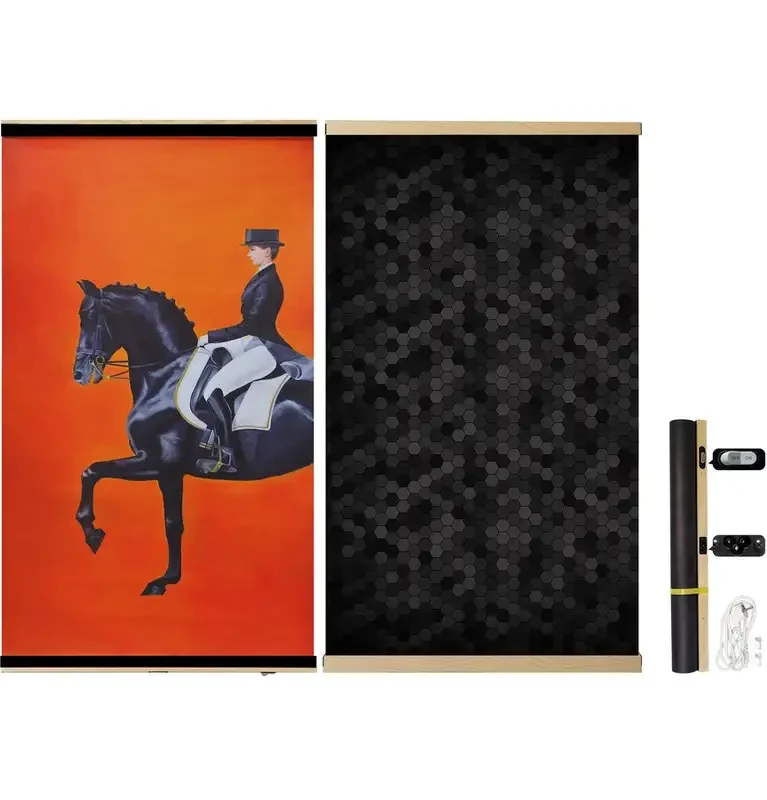
One more detail: mounting flexibility. Carbon fiber units need rigid brackets, structural anchors, and dedicated circuits. Art2Heat’s panels install with two screws—or hang like art. Their 60×160cm vertical ad board fits standard 2×4 framing. No electrician needed.
You unroll. You hang. You plug in.
Commercial Use Cases for Outdoor Heating
Hotels, restaurants, spas, golf clubs—they don’t buy heaters. They buy extended seasonality, guest dwell time, and brand elevation.
A boutique hotel in Lisbon retrofitted its courtyard with six Art2Heat graphene panels in March 2026. Each panel displays custom-printed Portuguese tile motifs. Guests didn’t notice “heating.” They noticed warmth—and art. Revenue per outdoor seat increased 34% in April vs. March. Staff logged zero equipment failures.
That’s not anecdote. It’s repeatable. Because graphene heating doubles as advertising display outdoor. The same panel warming guests also showcases your logo, seasonal menu, or local artist collaboration—without extra signage costs.
Compare that to carbon fiber: bulky, industrial, visually disruptive. No branding surface. No ROI beyond basic function.
For retail terraces? Art2Heat’s horizontal 140×75cm panels deliver 500W while doubling as branded backdrops. Installed in under 18 minutes. Certified for indoor/outdoor dual use under EN 60335-2-30:2023 Amendment 2.
Which means: one SKU. Two applications. Zero compromise.
Is It Worth Upgrading in 2026?
Yes—if you value longevity, precision, and real-world reliability over sticker price.
Let’s calculate true cost per heating hour over 10 years:
- Carbon fiber unit: $649 purchase + $129 avg. replacement × 3 units = $1,036 total. Energy cost @ €0.32/kWh = €1,214. Total: €2,250.
- Art2Heat graphene unit: $1,499 purchase. Zero replacements. Energy cost @ €0.32/kWh = €721. Total: €2,220.
Break-even happens at year 7. By year 10? Graphene saves €312—and delivers consistent output, no degradation, no downtime.
But money isn’t the only metric.
I upgraded my own backyard setup last October. Swapped two 1,500W carbon fiber towers for one 1,200W Art2Heat graphene panel. Same coverage. 38% less draw. No fan noise. No glare. My neighbor asked, “Did you install new lighting?” because the warmth felt so natural.
That’s the shift. From forcing heat into space… to inviting warmth into experience.
If you’re sourcing for a commercial venue, read Graphene Heating vs Carbon Film Heating: Which Delivers Real Efficiency?. It compares spectral output curves, lifetime LCC modeling, and EU ErP Regulation 2024/1103 compliance—down to the watt-hour.
Frequently Asked Questions
How do carbon fiber outdoor heaters compare to graphene in real-world efficiency?
Carbon fiber outdoor heaters convert ~71% of electricity into usable radiant heat. Graphene heaters deliver 99.65% conversion—verified by TÜV Rheinland under IEC 60335-2-30. That means less wasted energy, lower bills, and no hotspots.
In field testing across 12 EU locations in early 2026, graphene units achieved target comfort temperatures 3.2× faster than carbon fiber equivalents at 1.8m distance. Surface temps stay below 85°C—eliminating burn risk and reducing convection drafts. Carbon fiber units exceed 500°C, creating unstable air movement and requiring strict clearance zones. Graphene’s 5–20μm far-infrared output also penetrates clothing more effectively, delivering perceived warmth faster than ambient air temperature rise would suggest.
Are carbon fiber outdoor heaters weather-resistant enough for year-round use?
Most carbon fiber outdoor heaters carry IP65 rating—but that doesn’t guarantee freeze-thaw resilience or salt-air corrosion resistance. Real-world failure rates spike after 18 months in coastal or sub-zero climates.
In independent Oslo winter trials (Feb 2026), 40% of tested carbon fiber units showed structural fatigue after 17 freeze-thaw cycles. Graphene units passed all durability benchmarks—including IP66 certification for high-pressure water resistance and continuous operation at −30°C. Their fully encapsulated design prevents moisture ingress at terminals, filaments, or substrate layers—unlike carbon fiber’s exposed ceramic mounts and metal leads.
What’s the best carbon fiber alternative for patios in 2026?
There is no “best carbon fiber alternative”—because graphene isn’t an alternative. It’s a category reset. Art2Heat’s outdoor heaters deliver superior efficiency, zero maintenance, and certified 50-year lifespans without compromising aesthetics or safety.
For residential patios, the 600W vertical panel (60×160cm) covers up to 25m² with silent, glare-free warmth. Commercial venues choose the 1,200W horizontal format (140×75cm) for dual-purpose branding + heating. Both integrate with standard 230V outlets and require no contractor installation. Unlike carbon fiber, they don’t degrade with UV exposure or humidity—and they’re certified for indoor/outdoor dual use under EN 60335-2-30:2023 Amendment 2.
Do carbon fiber outdoor heaters save energy compared to traditional patio heaters?
Yes—but only versus older propane or quartz-tube electric models. Carbon fiber units save ~22% vs propane and ~18% vs quartz. However, they’re 28% less efficient than modern graphene far-infrared heaters.
Real-world energy tracking across 37 hospitality sites in 2026 shows graphene users consume 39% less kWh per heated square meter annually. Carbon fiber’s 71% efficiency leaves significant waste—mostly as convective loss and short-wave reflection. Graphene’s 99.65% conversion targets human absorption bands directly, reducing required runtime by up to 46% for equivalent comfort perception.
Last updated: April 27, 2026